

Why Traditional Press Release Platforms (EIN, PRWeb, and GlobeNewswire) Underperform

For many brands, the decision to rely on press release services is not driven by overconfidence, but by practical and budgetary constraints. Running media relations in-house is complex, resource-intensive, and difficult to scale internationally. Writing a solid press release is only a small part of the process; effective media relations require time, consistency, and a deep understanding of the market.
This challenge becomes even more visible for brands expanding into Europe or Latin America, where media ecosystems are fragmented, language-specific, and heavily driven by local relevance. What works in one country often fails in another, increasing both cost and operational risk.
At the same time, hiring external support is often far more complicated than expected. Brands expanding internationally face a fragmented PR landscape, unclear pricing models, and significant differences in media ecosystems across different countries. As a result, many companies turn to press release platforms not because they believe they are ideal, but because they seem like the least risky and most controllable option.
Large multinational PR agencies typically operate with high retainers, long-term commitments, and cost structures that are simply out of reach for many brands, especially those expanding internationally for the first time. These agencies are often optimised for global enterprises with established budgets and long planning cycles.
On the other hand, while strong local agencies exist in most countries, brands entering new markets often do not know which agencies to trust, lack local references, or are unable to properly assess their real media access. Managing multiple local agencies across different countries also introduces operational complexity that many teams are not prepared to handle.
Faced with this uncertainty, press release platforms often appear to be the safest and most accessible option. They offer predictable pricing, immediate execution, and the perception of global reach. From an operational or procurement perspective, they reduce friction and simplify decision-making.
However, while platforms solve certain operational problems, they frequently fail to address the actual visibility, credibility, and local media needs of international brands. This gap between expectation and outcome is at the core of why so many companies are disappointed with press release distribution.
Why traditional press release platforms underperform
Understanding the limitations of traditional press release services such as EIN Presswire, PRWeb, and GlobeNewswire requires stepping back and looking at the broader PR ecosystem. The issue is not execution quality, but structural design. Most traditional platforms were built to distribute content efficiently at scale, not to generate editorial interest or build local credibility in specific markets.
When brands expect these platforms to replace media relations, disappointment becomes almost inevitable. Distribution and media engagement serve different purposes, and confusing the two leads to unrealistic expectations around media pickups, local visibility, and overall impact.
Why press release platforms look appealing at first
Against this backdrop, press release platforms offer an apparently simple and low-risk alternative. Upload a release, select regions, pay a fixed fee, and distribution happens automatically. From an operational perspective, this feels efficient and predictable.
For many teams, especially those without in-house PR specialists, this approach seems like a practical way to achieve international press release distribution without having to manage journalists, pitches, or follow-ups directly. Platforms also generate tangible outputs such as published links, distribution reports, and dashboards that are easy to communicate internally, even if real media engagement is limited.
The real challenge of running media relations in-house
Effective media relations require far more than drafting announcements. Teams must build and maintain journalist databases, understand editorial priorities, pitch stories individually, follow up consistently, and adapt narratives to each market. Even well-resourced teams struggle to do this across multiple countries.
Beyond the operational workload, there is also a skills and access gap. Media relations rely on trust, timing, and credibility, all of which take years to develop. Without local knowledge and established relationships, in-house teams often send well-written but ineffective pitches that receive little or no response.
Why international PR agencies are often not an option
When internal execution becomes unmanageable, the logical next step is to look for external agencies. In practice, this option is frequently blocked by structural and financial barriers.
Large multinational PR agencies usually come with high retainers, rigid contracts, and global fee structures designed for enterprise clients. These costs are difficult to justify for brands testing new markets or operating with decentralised or regional budgets.
At the same time, while local agencies may be more affordable and effective within their own markets, brands expanding internationally often lack visibility into the local agency landscape. Without trusted recommendations, selecting and coordinating multiple local agencies quickly becomes risky, slow, and inefficient.
Structural limits of traditional press release services
Most press release platforms operate within closed or semi-closed networks. Content is published only on outlets and portals that have commercial agreements with the platform. These agreements are designed to ensure publication, not editorial review.
Because these networks are fixed, brands often see the same outlets republishing similar content repeatedly. Over time, this creates diminishing returns, limited audience growth, and a visibility ceiling that cannot be crossed without genuine editorial interest.
Why platforms are ineffective for local and multi-country strategies

One of the most damaging misconceptions is that global distribution equals local presence. In reality, platforms are weakest precisely where brands need them most: country-specific and local markets.
Local media rarely monitor global distribution feeds. They prioritise local relevance, familiar sources, and direct contact. As a result, brands may appear visible internationally while remaining invisible in the markets where they are actively selling, hiring, or building partnerships.
This is particularly problematic when companies rely on press release distribution across more than 60 countries as a substitute for market-level visibility, rather than as a supporting layer within a broader PR strategy.
SEO risks from repetition and non-indexation
Press release distribution is often justified as an SEO tactic, but repeated publication across the same networks can be counterproductive, especially when releases are reused across multiple markets without adaptation.
Duplicate content, low-authority domains, and non-indexed pages reduce the long-term value of links. In some cases, repeated releases dilute brand signals rather than strengthening them, leading to stagnation or decline in organic visibility.
Why editorial pickups remain rare
Press release platforms do not pitch stories. They do not adapt angles for specific journalists, respond to feedback, or follow up editorially. As a result, pickups remain rare and largely disconnected from the act of distribution itself.
When pickups do occur, they are usually driven by strong newsworthiness, external momentum, or existing journalist interest. In these cases, the platform acts as a publishing channel, not as the reason coverage happened.
Comparing traditional platforms with more effective alternatives
Recognising the limits of traditional press release services does not mean abandoning distribution entirely. It means using it differently and combining it with models better aligned with how media actually work today.
Market-specific distribution with guaranteed publications
A more effective alternative focuses on country-by-country distribution, prioritising relevance over volume. In this model, brands secure guaranteed publications in local media that accept corporate announcements under transparent conditions.
While this does not guarantee editorial endorsement, it ensures immediate and visible presence in target markets. For brands entering new countries, this local footprint is often far more valuable than broad but unfocused exposure.
The role of túatú as a hybrid alternative
An example of this alternative approach is the model developed by túatú, an international PR agency based in Europe.
Unlike traditional platforms or high-cost multinational agencies, túatú combines a scalable distribution platform with operational PR expertise. Brands can distribute press releases in more than 60 countries, either individually or through regional packages, without committing to global retainers.
In selected markets, túatú offers options that include guaranteed publications in relevant local media. This directly addresses two of the biggest gaps brands face: lack of local access and inability to justify multinational agency costs.
Rethinking what success looks like in press release distribution
The recurring disappointment with press release services is not a technical failure, but a mismatch of expectations. When success is defined as immediate editorial coverage, frustration is inevitable.
When success is redefined around being visible, searchable, and credible in the right markets, distribution becomes a strategic asset rather than a false promise. Traditional platforms still have a role, but they are not universal solutions.
For brands that cannot afford multinational agencies and do not yet have trusted local partners, hybrid models that combine distribution, local relevance, and guaranteed visibility offer a far more realistic path forward.
Looking for a more effective alternative to traditional press release platforms?
If your brand needs international visibility but cannot justify the cost of multinational PR agencies—or has seen limited results from global press release platforms—túatú offers a practical and scalable alternative.
túatú provides international press release distribution, with coverage across more than 60 countries, and flexible country-by-country or regional packages. In selected markets, brands can access guaranteed publications in local media, ensuring visible presence where it actually matters.
Discover how túatú can help your brand move beyond generic distribution and build real international media presence.

The Decline of Traditional Media: A Crisis in Journalism
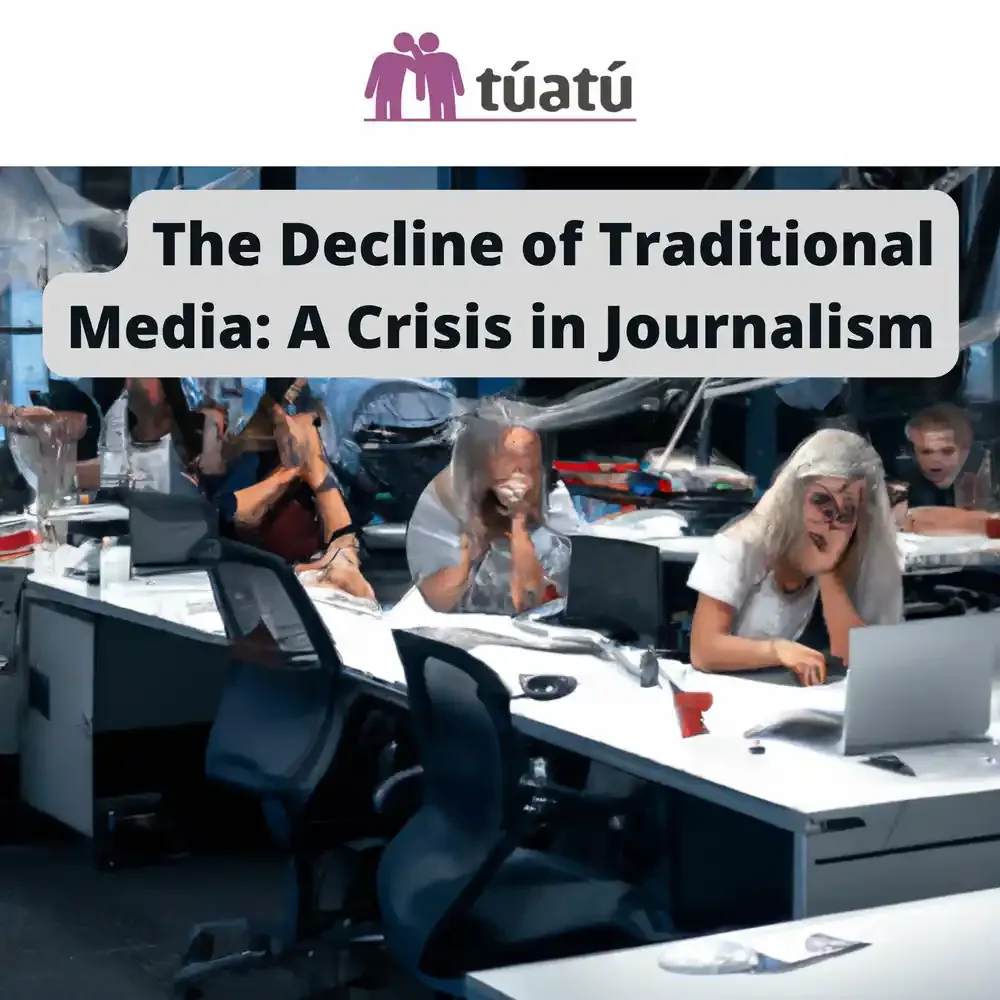
In the ever-evolving landscape of media consumption, the decline of traditional media outlets is a phenomenon that demands attention. From newspapers to television networks, the pillars of traditional journalism are facing unprecedented challenges, with ramifications extending far beyond the newsroom. As a PR professional deeply entrenched in the media ecosystem, it's imperative to dissect this issue and explore its multifaceted implications.
A Dwindling Readership and Influence
The traditional media, once revered as the gatekeepers of information, are experiencing a steady erosion of readership, reach, and influence. In an era dominated by digital platforms and social media, audiences are increasingly turning away from conventional sources of news and information. Circulation figures plummet, advertising revenues dwindle, and newsrooms shrink as media organisations grapple with the shifting sands of consumer behaviour.
The decline in readership is not merely a statistical blip but a reflection of broader societal trends. With the rise of digital alternatives and the ubiquity of smartphones, consumers have unparalleled access to a myriad of information sources at their fingertips. The immediacy and convenience offered by online platforms have reshaped how audiences consume news, relegating traditional media to the periphery of public consciousness.
The Shrinking Landscape of Journalism
Compounding the woes of traditional media is the dwindling cadre of journalists, whose ranks are thinning at an alarming rate. In Spain and beyond, newsrooms are witnessing a mass exodus of seasoned professionals, leaving behind a void that is difficult to fill. The reasons for this exodus are manifold, ranging from budgetary constraints to the allure of alternative career paths in the digital realm.
The decline in the number of journalists is not just a matter of personnel but a symptom of a deeper malaise afflicting the industry. As news organisations grapple with financial pressures and existential crises, the very essence of journalism is under threat. Investigative reporting, long-form journalism, and in-depth analysis—all hallmarks of traditional media—are casualties of this seismic shift, depriving society of critical voices and perspectives.
The Rise of Social Networks: A Double-Edged Sword
In the vacuum left by traditional media, social networks have emerged as powerful arbiters of public opinion, wielding influence on an unprecedented scale. Platforms like Facebook, Twitter, and Instagram have become virtual town squares where ideas are exchanged, opinions are formed, and narratives are shaped. The instantaneous nature of social media allows information to spread like wildfire, transcending geographical boundaries and ideological divides.
However, this newfound influence is not without its pitfalls. Unlike traditional media, which adheres to ethical standards and professional norms, social networks operate in a largely unregulated landscape. The proliferation of fake news, misinformation, and sensationalism has eroded trust in the media ecosystem, blurring the lines between fact and fiction. In the absence of editorial oversight, algorithms dictate what content reaches the masses, perpetuating echo chambers and reinforcing existing biases.
Navigating the Digital Paradigm Shift
As PR professionals, it is incumbent upon us to navigate the tumultuous waters of the digital paradigm shift with agility and foresight. The decline of traditional media necessitates a recalibration of communication strategies, wherein digital platforms assume greater prominence in our outreach efforts. Embracing social media, content marketing, and influencer partnerships can help bridge the gap between brands and audiences in an increasingly fragmented media landscape.
At the same time, we must remain vigilant guardians of truth and integrity in an age of rampant misinformation. By championing transparency, authenticity, and accountability, we can uphold the principles of ethical communication and mitigate the spread of falsehoods. Collaborating with reputable media outlets and supporting independent journalism initiatives can also play a pivotal role in preserving the integrity of the fourth estate.
In conclusion, the decline of traditional media represents a watershed moment in the annals of journalism—a reckoning that demands introspection and innovation in equal measure. While the challenges may seem daunting, they also present opportunities for growth, adaptation, and reinvention. By embracing change with resilience and resolve, we can navigate the currents of disruption and emerge stronger on the other side. Let us seize the moment and shape the future of media in a manner that befits its indispensable role in society.



Media relations Spain: Top 5 Way to Prepare for a Media Interview

Media relations Spain: Top 5 Way to Prepare for a Media Interview
No, you can't control how the interview will be conducted, nor can you control the outcome. But you can influence it greatly by the way you present your personality and your skills. Being interviewed is an opportunity for the interviewee to showcase their business, interest, or cause. Keep in mind that journalists are doing a job - they have deadlines to meet and word counts to adhere to. Knowing how to talk to the press can help improve your chances of receiving favorable media coverage.
However, to make the interview memorable and successful takes preparation. Here are a few tips that you can use when preparing for every interview including virtual book tours, blog radio interviews, live teleseminars, recorded interviews and traditional media interviews:
1. Prepare
When live on radio or television there is only one chance to get it right. Since you have more knowledge about the subject, its ideal to think about possible questions and also prepare your answers. Find out as much as you can about the program if it is pre-recorded or live? What are they expecting from you and what angle will you be talking from? - What are the question areas? Think about your most useful, interesting and relevant points to the appropriate audience.
2. Know your message
Have a few key talking points in mind and stick with them as much as you can during the interview. Have the facts and research prepared to back up these points and come up with a few anecdotes and have some examples ready to illustrate your points. Practice delivering your messages beforehand, so you weed out awkward phrases and prevent yourself from stumbling through your key points.
3. Be Buoyant & Enthusiastic
During an interview, boring answers will probably be edited out, and boring interviews will be dropped entirely. So make your delivery bright and enthusiastic, rather than boring and dull. Remember broadcasting is a performance! If you do not hold the audience's attention, there are plenty of rival channels people can switch over to.
4. Make It Interesting and Relevant
This is especially important in television and radio - both entertainment mediums. The more engaging you are, the easier it is for the interviewer to produce an exciting piece for their audience. Remember, you are in the spotlight, so act accordingly. Remember to stress the points that are likely to interest the listeners or viewers rather than just your internal messages.
5. Call to Action
Most people will remember the opening and closing of a radio interview. Always have a strong closing with a call to action, something you want listeners to do, i.e., attend the event or buy the product. And finally, remember to smile - when you smile you feel and sound much friendlier - and enjoy it!
Today, with the growing popularity of media, audiences in Spain, media interviewing is an effective way to reach and build credibility with a broad audience. Knowing how to talk to the press will ensure your key messages are clear and powerful - it's just another sale.